News and Analysis
- 26 September 2005
- 20 September 2005
After yesterday’s letter from the Venezuelan Ambassador, Alan Woods replies by stressing the contribution of the many comrades who have worked for several years to build up the Hands Off Venezuela within the British and international labour movement.
To Alfredo Toro Hardy,
Ambassador of the Bolivarian Republic in the UK.
Dear Ambassador,
Many thanks for your letter, which I received yesterday. Please convey my best wishes to President Chavez and my gratitude for his support. This message will undoubtedly encourage the supporters of the Hands off Venezuela Campaign and everybody who is fighting to support the Venezuelan Revolution against the monstrous aggression of US and world imperialism.
However, I consider that the President’s thanks should not be taken as a personal recognition of myself, or any other individual. I believe it is the elementary duty of every member of the international labour movement to do everything in their power to defend the Venezuelan Revolution and to defeat the plans of imperialism to isolate and undermine it. If I have been able to play a modest role in the necessary work of international solidarity, I consider that I have fulfilled my duty.
The passing of Resolution 79 at the TUC congress was achieved by the tireless work of many supporters of Hands off Venezuela over the last months and years. In the past few months, as you know, we have intervened with resolutions and meetings in practically every trade union congress in Britain, consistently raising the question of Venezuela, with excellent results. The vote at the TUC was the culmination of this work.
There are far too many people to mention individually. But I cannot fail to mention the important part played by outstanding trade union leaders like Jeremy Dear (NUJ) and NATFHE President John Wilkin, who presented Motion 79 at the TUC congress. Both unions have consistently supported HOV for a long time.
I must also mention the vital role played by John MacDonnell MP and Jeremy Corbyn MP, the leading figures in the left wing Labour Representation Committee, both of whom have shown themselves to be dedicated supporters of the Venezuelan Revolution and have given tremendous support to HOV.
My own contribution has been mainly in the field of international contacts. As you know, this year alone, I have visited Venezuela twice and maintained regular contacts with the revolutionary forces, and in particular with the leaders of the main trade union federation, the UNT. But all the credit for organizing the campaign’s work in Britain must go to the very able team of comrades organized by Jorge Martin and Rob Sewell, who have worked tirelessly for the cause. I could mention many others, but they are too numerous.
Finally, I cannot fail to mention my friend and comrade Orlando Chirino, a veteran of the Venezuelan workers movement and in my opinion the most outstanding trade union leader in Venezuela today, who came to the TUC at the invitation of the Hands off Venezuela campaign, defying a ferocious behind-the-scenes operation designed to prevent him from coming to the congress at all costs.
The Hands off Venezuela campaign was established almost three years ago, in response to the bosses’ lockout, when the counter-revolutionary oligarchy was preparing to overthrow the elected government of Hugo Chavez, which they had failed to do in the April 2002 coup.
At that time, HOV was only a small group of people in London. The great majority of the Left was not yet aware of what was really happening in Venezuela. We had very little support and very sparse resources. On the other hand, the reactionary forces of imperialism and the oligarchy had at their disposal colossal resources, including the might of the mass media.
At the present time, I am happy to say, the situation has varied substantially. More and more people are becoming aware of the real situation in Venezuela. The campaign against imperialist interference and bullying in Venezuela is gathering strength. And Hands off Venezuela has grown from very modest beginnings to a powerful campaign that is now active in more than 30 countries in five continents.
The work of HOV in Britain has put a lot of time and effort into the Labour and trade union movement because we have always believed that the international workers’ movement is the natural ally of the Bolivarian Revolution, and its best defence against imperialist aggression.
Our work has been constantly opposed, not only by the imperialists, but by the right wing of the movement, which does not want to have anything to do with socialism or revolutionary tendencies anywhere in the world. Backed by the state and the powerful mass media, they have been supporting the reactionary CTV “trade union” and doing their utmost to prevent the truth about the Bolivarian Revolution being known.
These right wing elements have attempted by every coneivable means to block the advance of HOV and to split the solidarity movement. In order to sow confusion, they have organized a campaign of disinformation that tries to present HOV as an “ultra-left” and “sectarian” campaign. This is entirely false.
Although the original initiative for setting up the HOV campaign came from the Marxists like myself, I should like to make it clear to you that, as a solidarity campaign, it is open to any individual or organization that is prepared to defend the Bolivarian Revolution and fight against imperialism.
As a Marxist, I have never concealed my own political views and have always advocated the position that the Bolivarian Revolution can only achieve final victory through workers’ power and socialism. That is my firm conviction, which I will always defend with all the energy I can summon.
But HOV is a broad solidarity campaign, in which people of different political persuasions participate freely and defend their views with equal conviction. All are welcome to participate – Marxists and Social Democrats, atheists and Christians, anarchists and flat-earthists. There is only one condition: that we must combine in action to defend the Venezuelan Revolution.
Socialism is democratic or it is nothing. A passionate debate on socialism and the future of the Bolivarian Revolution is taking place in Venezuela. That is very positive, and we are participating in this debate. The same debate will necessarily be reproduced in the international solidarity movement. That is a healthy development. Only reactionaries and bureaucrats fear such debate. Only through a free and democratic debate on policies and ideas can the workers’ movement advance and raise itself to the level of the tasks posed by history.
As time goes on, it is becoming increasingly obvious that the attitude of various tendencies to the Bolivarian Revolution is becoming the touchstone that determines the nature of every tendency in the world labour movement. The right wing reactionary forces and the bureaucracy are naturally hostile to it. The left wing and the working class rank and file are instinctively sympathetic.
The passing of a resolution unanimously by the TUC in support of Venezuela and opposing imperialism represents, as you say, a step forward of great significance in the struggle against the media misinformation campaign regarding Venezuela and the actions of its government. It represents a victory for the truth against the avalanche of lies, distortions and misinformation, which has been orchestrated in Washington, but which has been replicated by the reactionary forces in London and every other capital city in Europe. But it is also something more than this. It is a great victory for the Left in Britain and a defeat for the reactionary forces.
Therefore, Mr. Ambassador, in defending the Bolivarian Revolution, we are defending our own class interests. In fighting imperialism’s aggressive actions against Venezuela, we are also fighting imperialism and reaction everywhere else in the world. And in fighting those forces within the labour movement that are hostile to Venezuela and, either openly or secretly, support US imperialism, we are fighting to transform it from top to bottom and to return it to the path of socialism.
When President Chavez calls for world socialism as the only alternative to the nightmare of capitalist barbarism, he is expressing the fervent wishes of millions of working people, not only in Venezuela, but in Britain and in every other country in the world. This is a message that is far too important to be confined to the frontiers of any state. It is a message that corresponds to the actual needs of the world in which we live. It is a call to action that echoes through every continent and country.
John Wilkin said at the TUC “We need a bit of Bolivarianism in Britain”. But that is only another way of saying: the British Labour movement must return to its original aims. It must break with Blairism, capitalism and imperialism. It must reject privatisation and so-called market reforms and inscribe on its banner the socialist transformation of society.
Therefore, in expressing our solidarity with the Venezuelan Revolution, we are defending our own class interests. We are advancing the fight for socialism in Britain and internationally. We do not see these things as separate aims, but as one single, indissoluble struggle that is taking place on a world scale.
I thank you again for your kind interest in our work and wish you every success in your efforts to defend the Bolivarian Revolution.
Yours fraternally,
Alan Woods
London, 19 September 2005.
- 19 September 2005
- 19 September 2005
- 16 September 2005
- 15 September 2005
- 15 September 2005
- 12 September 2005
After the success in raising solidarity for Venezuela's Bolivarian Revolution at the British trade union conferences, the next step of the Hands Off Venezuela campaign will be the intervention at the Trades Union Congress in Brighton. NATFHE will move a resolution in support of Venezuela and the progressive policies of the government of president Hugo Chávez, committing the TUC to work with solidarity campaigns and to build links with Venezuelan trade unionists. NATFHE President John Wilkin, who has just returned from a trip to Venezuela in which he has established important links with the trade union and Bolivarian movement will be moving the motion. Find below the full text of the resolution and the amendments moved by other unions.
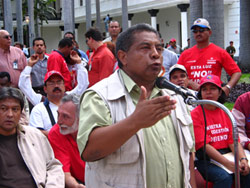 At the same time, a leading member of Venezuela's largest union, the National Workers Union, UNT, will be present at the TUC, having been invited by the National Union of Journalists and by Hands Off Venezuela. Orlando Chirino, who is a National Coordinator of the UNT, will be speaking at a fringe meeting, giving a unique chance to TUC delegates and other British trade unionists to hear first hand about the experiences and challenges facing the Venezuelan revolution and labour movement. Orlando Chirino is currently a member of the oil workers' union SINUTRAPETROL, but has more than 30 years experience in the trade union movement, particularly in the struggles of the textile workers in Valencia and Maracay. He will be speaking at a fringe meeting at the TUC on Wednesday and at a joint meeting on Colombia and Venezuela in London on Thursday, 15th.
Date: Wednesday, 14th September, 5.30pm (straight
after end of conference).
Venue: The Quality Hotel (2 mins from conference
centre), Brighton
Chair: Jeremy Dear (General Sec NUJ)
Speakers: Orlando Chirino, National Coordinator of the UNT, John Wilkin (President NATFHE, just returned from Venezuela), John McDonnell
MP, Bob Crow (General Secretary RMT) , Ruth Winters (President FBU)
79 Venezuela
Congress congratulates and supports the Venezuelan Government for its utilisation of the country's wealth and resources for reforms to benefit working people, the poor and the landless.
Congress notes the results of the referendum last August in Venezuela that gave President Hugo Chávez an overwhelming victory and a strengthened democratic mandate.
Congress further notes that these results confirm that there is overwhelming support among working people and the poor for the social programme of the Chávez Government in relation to education, literacy, job training, healthcare, land reform and subsidised food.
However, Congress views with alarm the bellicose statements being made by the US Administration and its allies in Colombia and the oligarchy in Venezuela which pose a real threat to these reforms.
Congress deplores the attempts of the United States Administration to intervene in the internal life of Venezuela and agrees to raise these concerns with the British Government.
Congress agrees to support wider trade union initiatives to highlight the issue of Venezuela within the British labour movement, including the organisation of a trade union delegation to meet and build links with Venezuelan trade unionists.
Furthermore, Congress will build and work with trade union endorsed organisations in the UK working to provide solidarity to Venezuela.
NATFHE - The University and College Lecturers' Union
Amendment
Add at end of paragraph 5: 'Congress expresses its solidarity with trade unionists in Venezuela and rejects any outside interference in their affairs.'
Association of University Teachers
Amendment
Add new paragraph at end:
'Congress is concerned about the lack of media coverage of events in Venezuela and urges the General Council to establish relations with the Venezuelan National Union of Workers (UNT) to ensure that news of trade union issues, at least, is more widely reported.'
Transport Salaried Staffs' Association
Amendment
Add new paragraphs at end:
'Congress notes the independent poll in July that showed over 70% support for Venezuelan President Hugo Chavez. It also notes the Venezuelan threat to suspend oil exports to the US if attacks on its government continue.
Congress resolves to support the Venezuelan people's efforts to preserve their democratically elected government.'
Associated Society of Locomotive Engineers and Firemen
- 06 September 2005
Chavez particularly lambasted the Bush administration’s lack of effort to help the poor in New Orleans to evacuate from the city before Hurricane Katrina hit. “How many children died there that could have been evacuated by land, by air, by water? Not one helicopter was moved before the hurricane came. Not one public use vehicle was moved. No bus nor military truck. Nothing,” said Chavez angrily. “And Mr. Bush is on vacation in Crawford, on horse,” he added in his rough English.
Chavez went on to discuss how much money the U.S. had spent on its war in Iraq and that it appears to be preparing for wars against Iran, North Korea, and Venezuela. “They are preparing to dominate the world,” said Chavez.
Despite his strong criticisms of how the Bush administration handled the emergency caused by hurricane Katrina, Chavez reiterated Venezuela’s solidarity with the people of the United States and his condolences for the hurricane victims. “Before anything else we gather the sentiment, the solidarity, the love of the people of Venezuela and send it to New Orleans, Louisiana, and to the entire coast of the Gulf of Mexico. We are, prior to anything else, moved by this tragedy,” emphasized Chavez.
Chavez drew a comparison to the tragedy that Venezuela suffered in December 1999, when torrential rains caused mudslides, killed an estimated 15,000 people, and made over 150,000 homeless. “It is the same face, drama, and pain, whether in English, Spanish, Chinese, or Guarao [an indigenous language], it is the same soul.”
In the course of the program, Chavez also spoke via phone to Felix Rodriguez, the CEO of CITGO, which is a subsidiary of Venezuela’s state-owned oil company PDVSA. In the course of the phone conversation Chavez informed viewers that Venezuela would increase its total aid package for the victims of the hurricane to $5 million, which would be distributed via CITGO.
Also, Venezuela is sending a tanker with 1.3-1.5 million barrels of gasoline to alleviate the gasoline shortage that the hurricane-struck area is currently suffering, where gasoline prices are nearing $7 per gallon.
While numerous refineries in Louisiana and the Gulf coast area were forced to shut down because of the hurricane, CITGO’s Lake Charles, Louisiana refinery is operating normally. CITGO even managed to increase its total refining capacity from 810,000 barrels of crude oil per day to 843,000 barrels per day, explained Rodriguez to Chavez.
Join / affiliate to the campaign!
 Please help build the campaign by joining as an individual or affiliating your trade union
Make a donation!
Hands Off Venezuela's financial resources are limited so we rely on our supporters around the world. Please make a donation of any size towards building the campaign